By Jack Mercer – Rabbit Hole Fisherman
Across the fjord from Longyearbyen, a summer camp offers kayaking, glacier walking and a turn on polar-bear watch. Getting into the Arctic means learning how to live there for a few days, including when to change your plans.
In This Story
- Longyearbyen, the base before the crossing
- Across Isfjorden to Ymerbukta
- A guide’s view of the place
- Fitness, ground and camp routines
- Light, weather and clothing
- Packing, boots and cold-water gear
- Guides, glaciers and decisions
- Polar-bear country
- Changing plans, staying flexible
- Leave no trace, even here
- The Arctic is changing
There is a small catch in the promise of sleeping under Svalbard’s midnight sun. Someone has to stay awake.
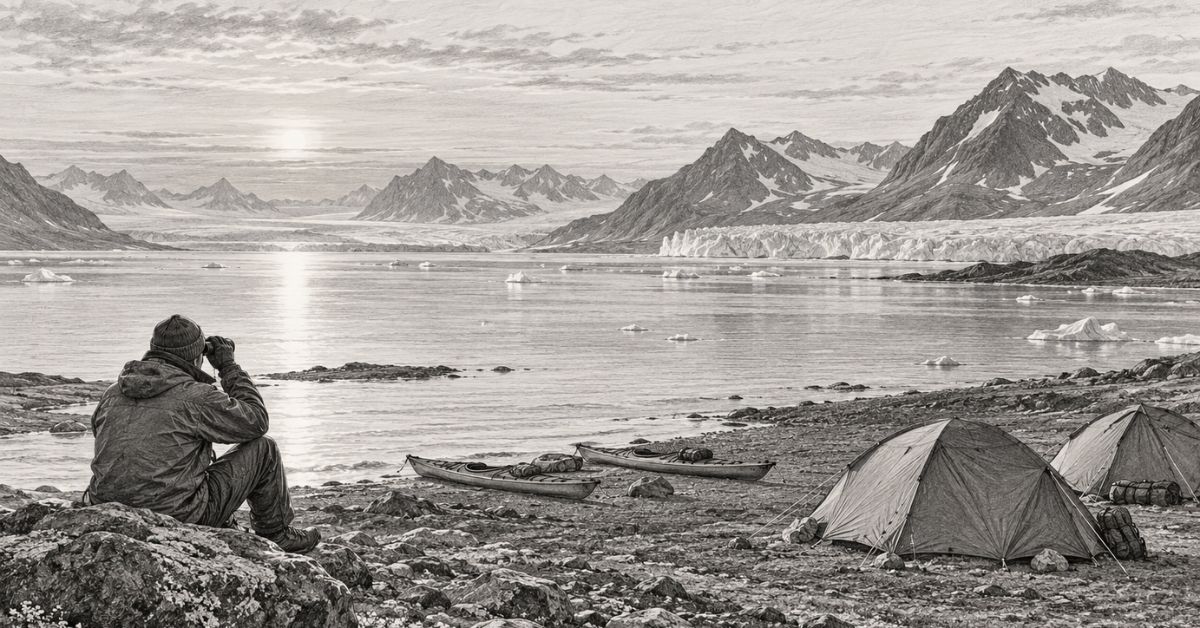
On the four-day Ymerbukta wilderness camp offered by Svalbard Wildlife Expeditions, guests share polar-bear watch as well as the cooking and washing up. The company asks prospective travellers to consider whether they are comfortable getting out of bed at three in the morning. It is a useful detail to encounter before booking. The photographs may have sold you the glacier. The roster needs your attention too.
For an Australian accustomed to checking a campsite for ants, this is a considerable adjustment. There is also something appealing about a holiday that gives you a job. You have to learn enough about the place to be useful to the people beside you.
Longyearbyen, the base before the crossing
The journey begins in Longyearbyen, on Spitsbergen, the largest island in Norway’s Svalbard archipelago. At about 78 degrees north, the town sits beside Adventfjord, with steep mountains around it. It has restaurants, shops and a cultural life, along with the practical services of a working community. Visit Svalbard traces its beginnings to coal mining, and records that Mine 7, the last Norwegian coal mine near town, operated until summer 2025.
It is tempting to treat somewhere this far north as a stage set for your arrival. People have groceries to buy here. The town is also where an expedition can gather its equipment and make the necessary arrangements before heading out. Appreciating both uses helps keep the traveller’s enthusiasm in proportion.
Across Isfjorden to Ymerbukta
Beyond it lies an awkward geography for anyone who likes to hire a car and improvise the rest. The Ymerbukta trip crosses Isfjorden by boat. The operator describes a crossing of about two hours, followed by setting up camp and a first outing in kayaks. Esmarkbreen, the glacier, is part of the reason to come. Later, there is a guided walk on the ice and scope for a longer mountain hike, with Värmlandsryggen ridge among the possibilities.
Four days gives the visit enough time to develop beyond arrival and departure. It also leaves some room for the weather to have its say. A fixed camp becomes a base from which to explore, rather than another place to pack up each morning.
A guide’s view of the place
One guide who has explained the attraction is Nanna, identified by her first name in an October 2020 interview reproduced in the company’s expedition diary. She had first visited Svalbard in 2014 and studied outdoor recreation. Asked about her favourite trips, she included the Ymerbukta camp, where guests could kayak at a safe distance from the glacier, walk on the ice and hike. She also liked a simpler walk, Blomsterdalshøgda.
That second choice is reassuring. A good day outdoors need not involve the hardest thing on the booking page.
In the same interview, Nanna advised guests to read the trip description and ask questions, especially about fitness and equipment. Her enthusiasm came with an expectation that people would choose something they could manage. It is advice that can sound obvious until the view in the photograph begins doing your thinking for you.
Fitness, ground and camp routines
The four-day camp is advertised as requiring good fitness, although previous kayaking or glacier-walking experience is not necessary. Training is provided. Visit Svalbard’s listing describes rough ground, including sand and rocks, and says guests participate in daily camp routines.
Being a beginner and being unprepared are quite different circumstances. You can arrive willing to learn a new skill while already knowing how your knees behave on uneven ground. Honest questions before departure are considerably easier than a discovery halfway through a hike.
Light, weather and clothing
Summer helps with the light. Svalbard’s bright season makes boat journeys and walking possible in a setting many people associate almost entirely with snow. The midnight sun lasts into late August. Later in that month and through September, the evenings begin to darken and the plants turn towards their brief autumn. Migratory birds give the summer a busier animal life than winter, while small plants add colour to the tundra.
There is a reason to spend time looking down as well as across the bay. A mountain can fill the background of every photograph and still leave you knowing very little about the ground you stood on to take it. Staying in one area gives you another chance to notice what you hurried past yesterday.
The daylight also needs separating from the temperature. Visit Svalbard’s clothing guidance gives an average of 3 to 7 degrees Celsius for the summer months, which it defines there as mid-May to September. It recommends warm layers, windproof clothing, a hat and mittens. Melting snow and ice raise rivers and streams, adding wet crossings to the practical questions a walking party may face.
An Australian summer wardrobe will require substantial revision.
Packing, boots and cold-water gear
Packing for a camp also takes a little more conversation than packing for a hotel. Establish what the operator supplies, what you carry yourself and which items must fit properly before departure. Boots deserve particular attention. There is limited entertainment value in discovering that yours rub, even with a glacier available to distract you.
Cold-water kayaking introduces its own equipment. The kayak clothing supplied for this camp includes a drysuit and life jacket. Glacier equipment is included too. These are things to learn to use, with guidance, before concentrating on the scenery.
A traveller’s account from elsewhere around Longyearbyen gives a useful glimpse of how that instruction changes a day. Writing for Earth Trekkers about a June 2018 outing across Adventfjord and up Hiorthfjellet, Julie Rivenbark described preparations involving drysuits and dry bags. Her guide, Nanna, set a 2.30 pm turnaround time for the mountain. Snowy conditions could also have ended the ascent early. This was a separate day trip, rather than the Ymerbukta camp.
The detail worth carrying across is the deadline. In continuous daylight, there is still a time to turn around. A guide has a whole journey to manage, including the return, while a guest can become rather attached to the next ridge.
It takes some discipline to accept a limit while you still feel capable of continuing. That is part of what you are buying when you join a guided expedition. You get another person’s judgement, formed with more information than your own desire to reach the top.
Guides, glaciers and decisions
Svalbard Wildlife Expeditions says its guides assess where and how to travel on glaciers, and check weather, sea and ice conditions before travelling across fjords. Its safety guidance also stresses keeping the party together and carrying polar-bear protection.
On the glacier, the equipment and the decisions belong together. Crampons and a harness cannot tell you which route is suitable that day. A visitor can enjoy learning how to move on ice without mistaking a few hours of instruction for the ability to organise the next outing alone.
Polar-bear country
Back at camp, the watch makes the same point in a more stationary way. The Norwegian Polar Institute warns that bears can be encountered in summer on beaches, in valleys and on glaciers. Its advice on camps includes choosing places with good visibility and avoiding locations where bears have recently been seen. It also explains that food smells can attract bears, making storage and waste handling part of camp safety.
This gives the washing up a significance it rarely enjoys at home. Camp routines deserve attention even when the weather is lovely and everyone would prefer to keep looking at the water. A guided trip lets you take part within an organised system, with the briefing defining your responsibilities.
The rules protect the animal as well. Changes introduced on 1 January 2025 set a minimum distance of 300 metres from polar bears, increasing to 500 metres from 1 March to 30 June. The Governor’s guidance also prohibits unnecessarily disturbing, attracting or pursuing them. For someone walking in the field who discovers a bear at close range, the requirement is to retreat. The guidance specifies exceptions to that retreat obligation for occupied facilities, including tents.
Changing plans, staying flexible
A bear in the area may mean a change of plan. Visit Svalbard’s camp listing explicitly allows for returning to Longyearbyen and doing day trips instead. Weather, ice and the group’s capabilities can alter the itinerary too.
Read that condition before paying. If your measure of success depends on completing every advertised activity, you have given the guide a difficult audience. Returning without the expected photograph may be the result of a sensible decision made early enough.
There are arrangements behind the camp that guests will never see. Commercial tourist camping requires permission from the Governor, with applications due at least four weeks beforehand. The Governor’s current travel guidance requires an organised, vigilant polar-bear guard at camps subject to application. It also explains that travel requirements depend on the activity and the area.
The regulatory picture is developing. Field Operation Safety Regulations took effect on 1 January 2026. The Governor says the requirement for tourist businesses and field operations to use approved Svalbard guides outside inhabited areas starts on 1 July 2027. The regulations also address rescue-cost insurance. Anyone planning a future trip should ask the operator how the rules applicable to their departure are being met.
That is a reasonable booking question. So are questions about equipment, the demands of the walking and what happens if conditions prevent the camp from operating. Clear answers make it easier to arrive with realistic expectations.
Leave no trace, even here
There are smaller obligations once ashore. Visit Svalbard asks travellers to leave flowers unpicked, avoid disturbing wildlife and leave no lasting signs of their stay. The Governor’s travel guidance explains that traces of human activity from before 1946 are automatically protected, with further protections for graves and certain remains. Old objects belong where they are found.
An apparently empty place can contain quite a lot that a visitor should leave alone. Looking closely becomes a more satisfying occupation when it does not end with putting something in your pocket.
The Arctic is changing
Nor is the ice a permanent backdrop. Copernicus identifies Svalbard as one of the fastest-warming places on Earth, reporting warming of around 1.5 to 2 degrees Celsius per decade over the past 30 years in its European State of the Climate 2025 material. A visit offers a chance to learn about a changing environment, although arriving there is hardly a contribution to fixing it.
For now, the practical attraction of Ymerbukta remains the time it allows. You can spend several days in a small area, learn unfamiliar equipment and become better company in a camp. There is room for a walk to occupy more of your attention than arranging the photograph afterwards.
If a turn on watch is part of your night, the guide will explain what you need to do. Then the rest of the group can sleep. You have warm clothing, a clear responsibility and a stretch of Arctic daylight to pay attention to.