By Jack Mercer – Rabbit Hole Fisherman
Leave a fresh beetroot in the kitchen long enough and it will eventually be
fit for the compost. Put it through a cannery, however, and it can spend years
in a cupboard without refrigeration. The explanation takes us from a French
inventor working more than 200 years ago to some surprisingly sophisticated
food science. And it turns out that the vinegar in your beetroot is doing more
than making your sandwiches taste better.
In This Story
- The man who preserved food before we understood germs
- What happens to a beetroot in a cannery?
- The vinegar has a second job
- Why doesn’t it turn into red porridge?
- Is the old beetroot still nutritious?
- The date on the bottom isn’t always an expiry date
- A familiar name from North Brisbane
- The next time you find an old tin
There’s a peculiar sort of archaeology that takes place in the average
Australian pantry. Somewhere behind the pasta, the half-used packets of rice
and the bottle of sauce nobody particularly likes, you find a tin of beetroot
that appears to have been purchased during a previous era of your household’s
history.
Perhaps it was intended for a barbecue. Perhaps somebody was going through a
phase of making proper hamburgers, the Australian kind with beetroot and an egg
threatening to slide out the side.
Either way, the tin has been forgotten.
You turn it over, look at the date and discover that the manufacturer expected
it to last considerably longer than you remembered.
The beetroot was harvested, cooked, packed and sealed years ago. Yet,
assuming the food was properly processed and the can has remained intact and
appropriately stored, it may still be perfectly suitable for lunch.
Fresh beetroot is considerably less accommodating. It can survive for a while
under good storage conditions, but leave it long enough and moisture loss,
microbial growth and the vegetable’s own biological processes will eventually
take their toll.
The canned version has somehow escaped most of that trouble.
To understand how, it’s worth meeting a Frenchman who was trying to solve much
the same problem before anyone had a satisfactory explanation for why food
spoiled.
The man who preserved food before we understood germs
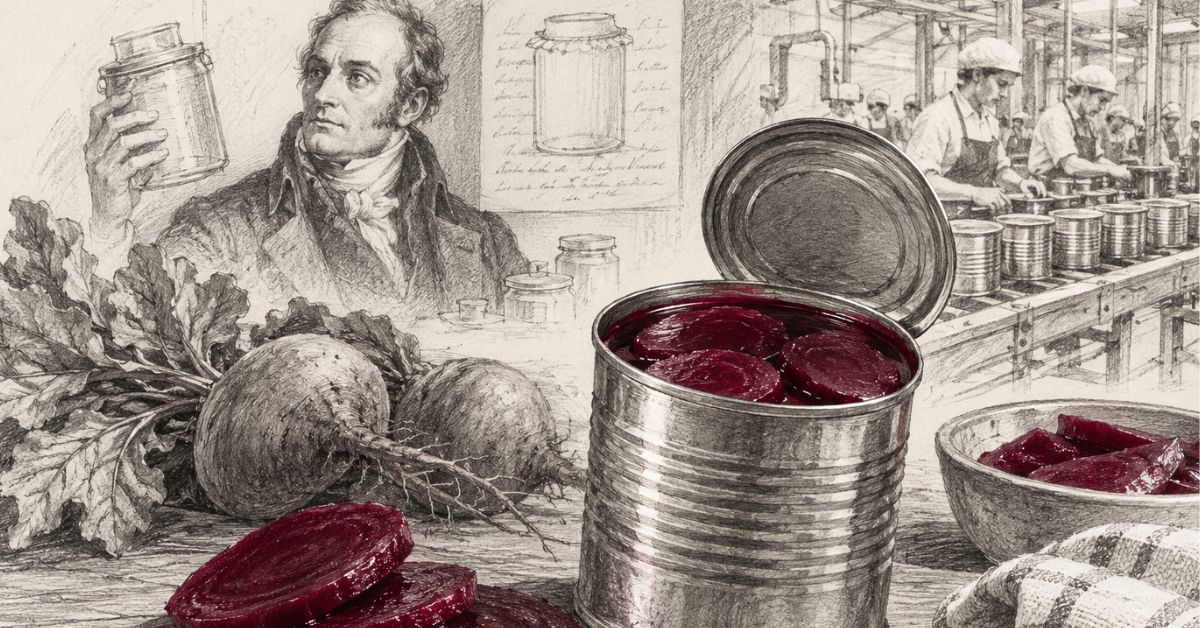
Nicolas Appert was a French confectioner and food preserver who spent years
experimenting with ways to stop food deteriorating. His work attracted the
attention of a government with a practical problem: armies and navies needed
provisions that could survive long journeys without becoming inedible.
In 1810, Appert published his findings in a book describing methods for
preserving animal and vegetable foods.
His approach involved putting food into containers, sealing them and heating
them. He worked with glass vessels, not the familiar supermarket tins that
would become widespread later.
The remarkable part is the timing.
Louis Pasteur’s work explaining the role of microorganisms in fermentation and
spoilage was still decades away. Appert had discovered a practical preservation
method without knowing precisely what was happening to the microscopic
organisms responsible for much of the deterioration.
He knew that the method worked, even if the science behind it remained
incomplete.
The method was far from perfect by modern standards, and early preservation
systems had limitations that later research would expose. Nevertheless, Appert
had helped establish the principles on which an enormous food industry would
eventually be built.
Within the same year, the English inventor Peter Durand received a patent for
food preservation using tin-plated iron containers. Metal cans gradually became
a practical alternative to glass, particularly for transporting provisions.
Two centuries later, a supermarket tin of beetroot owes something to both men.
What Appert couldn’t have explained is that heating food under controlled
conditions can destroy or inactivate microorganisms, while a properly sealed
container helps prevent fresh contamination.
Modern canneries have spent generations refining that process. The temperatures,
heating times, container designs and food formulations are all carefully
considered, because getting the balance wrong can produce anything from
unpleasantly mushy vegetables to a serious food-safety problem.
What happens to a beetroot in a cannery?
Imagine the beetroot arriving from the farm. It carries soil, has a tough outer
skin and looks very little like the neat red cubes that eventually appear on a
supermarket shelf.
Commercial preparation generally involves cleaning, trimming, cooking or other
preparation, and cutting the beetroot into the form required for the finished
product. The details vary between factories and products, and the order of
operations isn’t identical everywhere.
The prepared vegetable is packed with its liquid, and the food and container
undergo a validated preservation process.
That word, validated, matters. Food processors need evidence that the chosen
treatment will control the relevant microorganisms under the conditions in
which the food will be sold and stored.
Heating a vegetable until it is tender enough for dinner is one thing.
Producing a container of food that can remain safe on a supermarket shelf for
an extended period is another.
The seal is just as important as the heat treatment. A properly processed
product could be contaminated again if microorganisms were able to enter
through a faulty container.
Once sealed and processed correctly, the contents are protected from the
ordinary environmental contamination that helps make fresh food deteriorate.
There is a catch, though. Different foods require different treatment, and the
distinction has a great deal to do with acidity.
The vinegar has a second job
Australian beetroot has a long association with vinegar and sweetness. For
anyone who grew up eating beetroot on hamburgers or beside a plate of cold
meat, the sharp, sweet liquid is as familiar as the vegetable itself.
Look at the ingredients of a typical canned beetroot product and you may find
beetroot, water, sugar, salt and an acid such as acetic acid.
Acetic acid is the principal acid in vinegar. It contributes the tangy taste,
but it also changes the environment in which microorganisms would have to
survive and grow.
Food scientists measure acidity using the pH scale. A lower pH indicates
greater acidity, and one particularly important dividing line in food
preservation is pH 4.6.
The number matters because of Clostridium botulinum, a bacterium capable of
producing an extremely dangerous toxin under suitable conditions.
Its spores are unusually resistant to heat. In low-acid foods, simply boiling
the contents at ordinary atmospheric pressure cannot be relied upon to control
them.
Properly acidified foods, with an equilibrium pH of 4.6 or below, help prevent
the growth and toxin production of this organism when they are also properly
processed and sealed. The required processing method still depends on the
complete product and its formulation.
This is why a can of beetroot in an acidic liquid and a can of plain sweetcorn
may need quite different preservation processes.
Corn is generally a low-acid food. Commercial processors must account for that
when determining the necessary heat treatment, which may involve temperatures
above the boiling point of water under ordinary atmospheric pressure.
Acidified beetroot can be processed under different conditions, provided its
acidity and other safety requirements are properly controlled.
That distinction is also why recipes for preserving vegetables at home cannot
safely be improvised by guessing how much vinegar to add or how long to boil a
jar.
In a commercial cannery, the process must be designed around the actual food
being packed.
And what about the sugar?
It certainly contributes to the flavour. At high enough concentrations, sugar
can also help preserve food by reducing the water available for microorganisms
to use. Jam is a familiar example.
But the sugar content of ordinary canned beetroot shouldn’t be assumed to
provide that sort of protection on its own. The same applies to salt. Both
ingredients can influence the finished product, but their presence doesn’t
remove the need for an appropriate preservation process.
For a food that looks so uncomplicated on the plate, quite a lot depends on
getting the chemistry right.
Why doesn’t it turn into red porridge?
There is another puzzle here, especially for anyone who has ever left vegetables
boiling on the stove while distracted by something more interesting.
Heat softens vegetables. Too much heat can leave them barely recognisable.
Yet canned beetroot usually emerges in reasonably distinct slices or cubes,
soft enough to eat but firm enough to hold together.
Plant tissue gets much of its structure from cell walls and the substances that
help bind cells together, including pectin. Cooking alters those structures,
which is why a raw beetroot feels so different from a cooked one.
Food processors must balance the treatment needed for safety against the texture
customers expect. The balance varies with the vegetable, its size, its
preparation and the product’s formulation.
Some processed vegetables use permitted firming agents to help preserve their
texture. Others rely on the natural properties of the vegetable and the way it
is processed.
A glance at the ingredients can help establish which applies to a particular
product.
Beetroot is also rather generous with its colour. The red liquid that stains
your fingers, the chopping board and occasionally your shirt contains pigments
called betalains, which give the vegetable much of its characteristic
appearance.
These pigments can move into the surrounding liquid and are affected by
processing conditions, including heat and acidity.
So the liquid in the can isn’t simply a flavouring mixture that happens to be
red. Some of that colour has come from the beetroot itself.
It also explains why the vegetable and the liquid may change in appearance over
time without that change necessarily indicating spoilage.
Is the old beetroot still nutritious?
The common assumption that fresh vegetables must always be nutritionally
superior to canned ones doesn’t survive much scrutiny.
There are differences, certainly, but they depend on the vegetable, the nutrient
and what happens to the food between harvest and consumption.
Heat-sensitive vitamins can be reduced during processing. Vitamin C is one
example, although the extent of any loss depends on the conditions involved.
Minerals are generally more stable under heat, while some water-soluble nutrients
may move from the vegetable into its packing liquid.
Fresh produce has its own complications. Nutrient levels can change during
transport, storage and cooking, particularly when vegetables spend extended
periods between harvest and the dinner table.
Canning also has a substantial practical advantage: it makes vegetables
available when fresh produce is expensive, out of season or inconvenient to
prepare.
None of that means a three-year-old tin contains precisely the same nutrients as
it did when it left the factory. Some components may deteriorate during storage,
and flavour, texture and colour can change.
Food safety and eating quality follow different clocks.
A properly preserved product may remain microbiologically safe after its flavour
or appearance has begun to decline.
The date on the container helps consumers understand the manufacturer’s
expectations, although there are some subtleties to Australian date-labelling
rules.
The date on the bottom isn’t always an expiry date
Australian food labels distinguish between best-before and use-by dates.
A best-before date generally concerns the period during which food is expected
to retain its quality, assuming appropriate storage. A product can sometimes
remain safe and suitable after that date, although its quality may have
declined.
A use-by date has a different meaning. Food carrying one should not be eaten
after that date.
Some shelf-stable foods with a shelf life of two years or more are exempt from
mandatory date marking under the Food Standards Code, although manufacturers
may still choose to provide one.
The condition of the can matters independently of any printed date.
A container that is swollen, leaking, badly rusted or damaged around a seam may
no longer be safe. Serious damage can compromise the barrier that protects the
food from contamination.
Nor is it wise to rely on a sniff or a tentative taste to determine whether
suspicious canned food is safe. Some dangerous contamination cannot be
reliably identified that way.
The sensible approach is to follow the manufacturer’s instructions and discard
cans showing warning signs.
Once a can is opened, its long shelf life is over. The contents are exposed to
the environment and need appropriate refrigeration and handling, just like
other perishable foods.
The technology that kept the beetroot stable for years depended on the food
remaining in its correctly processed, sealed container.
A familiar name from North Brisbane
For Queensland readers, Golden Circle provides a local connection to the
history of food preservation.
Its cannery opened at Northgate in North Brisbane in 1947, at a time when
processing locally grown fruit and vegetables was a substantial part of the
state’s manufacturing economy.
The Northgate factory continues operating, and Kraft Heinz says it now produces
over 150,000 tonnes a year of canned pineapple, fruit juices and cordials.
Golden Circle’s history is a reminder that the ordinary canned foods we keep in
our cupboards come from an industry requiring considerable engineering, technical
knowledge and agricultural organisation.
There is a separate story to be told about how Australian food manufacturing has
changed. For the moment, though, the tin of beetroot offers enough to think
about without following it all the way through the international food trade.
The next time you find an old tin
Appert’s early experiments required an extraordinary amount of patience. He had
to work out which combinations of heating, sealing and storage actually kept
food from spoiling, long before microbiologists could explain the results.
Today, a commercial processor can measure acidity, specify heating conditions,
test seals and validate a preservation process using knowledge that would have
been unavailable to him.
The result is so commonplace that most of us scarcely notice it.
We buy beetroot, put it in the cupboard and forget about it until the next
barbecue.
The tin might have been sitting there for three years, but the real question
isn’t how the beetroot has managed to survive for so long.
It’s how much work went into making sure it could.